Architecture
Overview
The application follows a Frontend-Backend / P2P Node architecture. Currently, state is authoritative on the Backend and replicated to Frontends via WebSockets. However, the system is designed around a Split Node concept where each player runs their own Backend and Frontend, eventually communicating peer-to-peer.
- Frontend: A WebAssembly (WASM) application built with Rust and
egui(viaeframe). It runs in the browser. - Backend: A Rust native application building on
axumandtokio. It manages the game state, serves assets, and handles network transport. - Shared / Cryptography: Common crates containing data structures, game logic, communication protocols, and cryptographic primitives for verifiable actions.
- CGDSL: A Card Game Domain-Specific Language designed to formalize rules and generate game execution state machines.
Architectural Concepts
1. Split Node Architecture
The system is designed around a Split Node concept.
- Each Player is a Node: Every user runs a full instance comprising both the WASM Frontend and the Native Backend.
- Thin Client: The Frontend is strictly a view layer ("Game state -> Pretty pictures"). It handles input and rendering but contains minimal game logic.
- Native Power: The Backend handles all heavy lifting: game engine execution, cryptography (ZK proofs), and P2P networking. This bypasses WASM limitations (sandboxing, lack of threading/sockets).
2. P2P & Transports
The system supports multiple transport layers:
- WebSockets: For communication between a Frontend and its local Backend. (Using
Frontend2BackendMsgandBackend2FrontendMsgas message types) - Iroh: A P2P library used for node-to-node communication (with
Peer2PeerMsg), featuring NAT traversal and hole punching. - QR Codes: An alternative transport for exchanging data (and potentially bootstrapping connections) in air-gapped or localized settings.
3. Actor-Based Connection Model
To handle the complexity of multiple asynchronous connections (Frontends and Remote Peers), the backend utilizes a custom Tokio-based Actor Model using channels for message passing. This ensures that the state processes actions sequentially and prevents race conditions.
Message Flow Example: Player takes an action
- Local Action: The player selects an action in one of their connected Frontends.
- WebSocket Routing: The corresponding
Frontend WS Actorreceives the message and forwards it via atokiochannel to theSupervisor. - Execution & Proof: The
Supervisorsends a message to the dedicatedGame Engine Actorvia a channel. The Engine Actor evaluates the action, uses theCryptography Layerto generate a Zero-Knowledge Proof, and transmits the result back to theSupervisor. - State Update: The local authoritative state is updated by the
Supervisor. - Broadcast: The
Supervisorsends the action and its ZKP to all connectedP2P Actorsand broadcasts the new state to allFrontend WS Actors. - Network Transmission: The
P2P Actorsforward the data to the connected Remote Nodes. - Remote Verification: When a Remote Node receives the message, its
Supervisorforwards the ZKP to its ownGame Engine Actorfor verification through its crypto traits before applying the state transition.
System Components & Interfaces
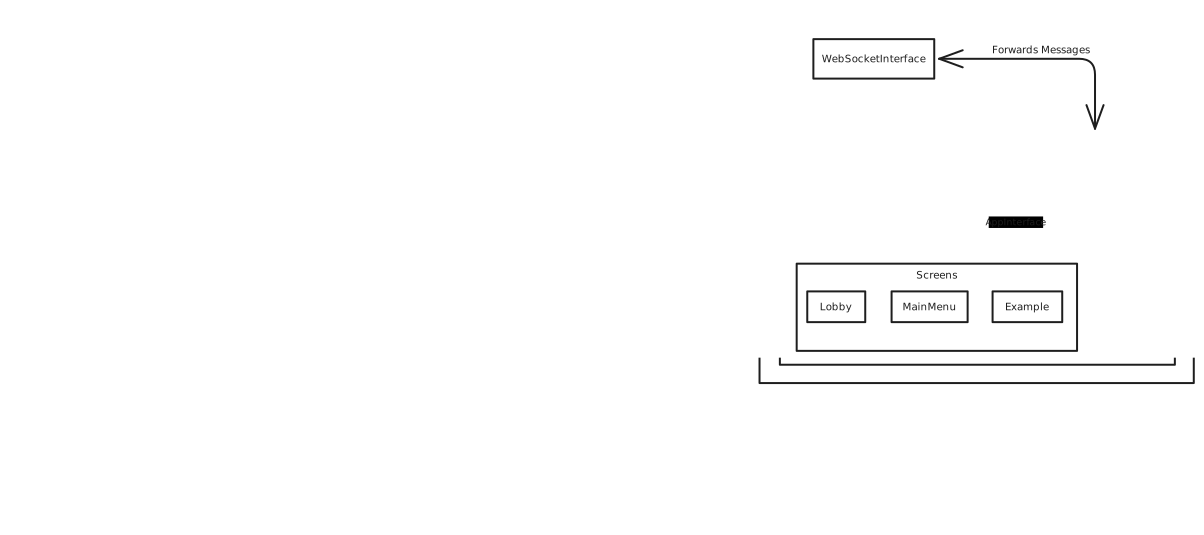
The following diagram illustrates the boundaries and communication paths within a single player's Node, as well as its connection to the outside world. The following diagram illustrates the components in the workspace and their relationships.
New Actor Model
Backend
Network & Connection Lifecycle
- Out-of-Protocol Discovery: Initial peer discovery is handled out-of-protocol. For example, a player might scan a QR code or copy a connection string from another player to bootstrap the first connection.
- In-Protocol Advertisement: Once an initial connection is established, further peers are discovered via in-protocol gossip or advertisements (e.g., Player A introduces Player B to Player C).
- Frontend Independence: The backend does not depend on a connected frontend to maintain these P2P connections or process background state. Frontends can connect or disconnect at will without interrupting the node's P2P responsibilities.
File Structure
The project has been restructured to cleanly separate the communication layer from the core backend logic, and to extract the game engine into its own independent crate. The following diagram illustrates this organization using a tree view representation.
Workspace
├── native_mcg
│   └── src
│       ├── main.rs
│       ├── lib.rs
│       ├── context.rs
│       └── communication
│           ├── mod.rs
│           ├── supervisor.rs
│           ├── ws.rs
│           └── p2p.rs
└── engine
    └── src
        ├── actor.rs
└── lib.rsnative_mcg/src/context.rs: The heart of the native backend. This module defines theContextstruct, CLI argument parsing, configuration loading, and core business logic handling.native_mcg/src/communication/: Contains the implementations for the actor model. This includes theNetworkSupervisor(which abstracts the network layer) and the specific transport actors (ws.rsfor WebSockets,p2p.rsfor Iroh peer-to-peer).engine/: The Game Engine has been moved out of the backend into its own dedicated crate. It operates as its own actor (actor.rs), capable of receiving and transmitting messages independently.
Class / Struct Diagram
In this architecture, the Network Supervisor serves purely as an abstraction layer for the Context. When a network message is received by a tiny connection task (either via a WebSocket from a local frontend or over Iroh from a remote peer), the task forwards it to the Supervisor's MPSC channel. The Supervisor's receive method then forwards it to the Context. The Context then processes the message, updating its state or interacting with the Game Engine as needed.
Key Relationships
- Context Initialization:
main.rsparses theCliArgsand loads theConfigwhich in turn is used to initialize theContext. - Network Abstraction: The
NetworkSupervisorshields theContextfrom the intricacies of connection management. It holds all connections into which the context can write. Tiny connection tasks forward incoming messages into the Supervisor's channels (ws_rx,p2p_rx), and the Supervisor funnels them to theContextviacontext_tx. - Engine Independence: The
GameEngineActorresides in a separate crate and evaluates the actions based on the cryptographic traits. TheContextinteracts with it via message passing.
Cryptography Abstraction
Since multiple ZKP protocols will be implemented to support the various mental card game requirements, the cryptography layer is heavily abstracted behind Traits. The Game Engine interacts exclusively with these traits rather than concrete implementations, allowing for flexibility, swapping of protocols, and cleaner testing.